January 31, 2024 Even though I wrote this months ago, I am pushing it up on the timeline. There is important information here that can help you avoid many of the mistakes that I made. Some of mine resulted in very serious and near-fatal consequences — I don’t want that to happen to you!
Choosing a doctor should be a no-brainer: You consult your computer to find a board-certified physician within <<#>> miles of your residence who treats your special problem, and then you call to make an appointment.
Easy peasy, right?
WRONG! WRONG! WRONG! WRONG! WRONG!
If you don’t believe good medical care is hard to find, just read some of the entries I have posted on this site.

I developed this plan because, after making two terrible mistakes, I want to be well-informed and confident in choosing a qualified, trustworthy doctor.
I hope this process will save you time and steer you from careless providers whose ignorance could cause great harm. And if you are looking for a new physician after having been injured by a lousy doctor or his/her staff, these suggestions might help you avoid mediocre practitioners who seem okay at first. . .but you will soon discover they ignore their own Hippocratic oath — primum non nocere (first do no harm) — with inadequate care and by staunchly defending their ignorant colleague(s) and demanding that you do the same.

Here is what helped me:
- Not all board-certified physicians are good physicians. Remember that 50% of all medical students graduate in the bottom half of their class, and that includes classes at such prestigious universities as Harvard and Johns Hopkins. Board certification will not reveal if your doctor was one of them. So, before choosing a physician,
- Look online at your state licensing agency to see if there are any complaints lodged against your prospective choices. (If your doctor has practiced in other states, be sure to check their licensing agencies as well.)
- Make a note of what colleges and schools they attended. Many of the schools located outside the United States, especially those in the Carribbean, India, and in other struggling countries, accept low MCAT scores and low GPAs. In my opinion, this is less trustworthy than a degree obtained from most American schools, which have much higher standards.
- It goes without saying that any provider you choose should have a good command of the English language.
- Sometimes you may see the initials “MBBS” rather than MD following the physician’s name. This denotes lesser training obtained at a foreign university or hospital. The MBBS requires only undergraduate studies and not the more stringent postgraduate studies mandated for MD candidates.
- Of note, Ajay Dhakal, the Rochester, NY doctor whose ignorance nearly killed me, has an MBBS degree. I later found out that he graduated from the Kathmandu Medical College and Hospital. . .with a grade 73.01 percentage. This translates to a C- with a GPA of only 2 , which is wholly insufficent by American standards.
- Also, be wary of foreign-trained doctors for a second, equally important reason: Some cultures inherently devalue women. Ajay Dhakal, for example, is from Nepal and my next oncologist from India. These countries are among those that degrade women both in law and society. The resultant cultural bias contributed, in my opinion, to the lousy care they rendered.
- Cultural bias is not limited to male practitioners, Female doctors may do this, too, as my experience with Shipra Gandhi, MD, proves (Buffalo NY).
- Don’t forget to check any social media pages the doctor and/or institution has. LinkedIn is a good one; that’s where I discovered that Dr. Dhakal barely graduated from the Kathmandu College and Teaching Hospital.
- Look at how long your candidates have been practicing. Education matters, but so does experience.
- Have they consistently maintained a local office, or did they move from place to place in a relatively short period of time? It might be safer to choose the physician whose practice history does not suggest s/he was running away from something unpleasant.
- Ask your friends, relatives, and other people you trust about who they see for their own medical care.
- Listen to their replies. Does what they say make sense to you? Would you be satisfied seeing that doctor, given what you have learned?
- Read every online review that mentions the doctor and the institution with which s/he is associated. Look especially for the one-star reviews — that is where you will get the most honesty.
- BTW, I know of a local orthopedic practice that limits reviews to those with five-star comments, so be careful if you find superlative ratings from every single reviewer. (I’m thinking David A. Carrier, MD of Rochester NY here and also Joel McFarland, MD, a gastroenterologist also from Rochester NY.)
- Make a list of prospective candidates and then make an appointment to INTERVIEW each one (if you are already receiving care, tell your insurance about this second opinion, and they will pay their share for the visit).
- When you call for the appointment, how was your interaction with the staff? Did the phone ring incessantly before the receptionist got around to answering it? When you arrived for your appointment, did you end up watching the staff play on their phones while you waited for them to acknowledge you? Lousy doctors are prone to hiring lousy staff, as Dr. Surinder Devgun’s choice of a receptionist proves (Rochester, NY). If making the appointment was difficult or if the staff were curt, neglectful, or insulting, chances are the doctor will be, too.
- Ask questions about your disease. Ask how they would treat it. Ask about what ancillary services they offer. If your doctor dismisses your questions or answers vaguely, reluctantly, or not at all, cross that name off your list.
- Ask about their availability — will they answer your calls and questions, or will they schlep you off to a nurse? Or to a medical student? Or do you get the feeling that they might ignore your call or email altogether? <——a tactic preferred by Ajay Dhakal, which delayed the diagnosis of typhlitis until it had already perforated and become near fatal.
- And above all, ask questions about what they expect from you, the patient.
- If you do not get clear, understandable answers or if the doctor seems impatient or inattentive, or if s/he seems patronizing in any way, thank him/her very kindly, cross that name off your list, and move on.
- If you have been traumatized by poor medical care to the point of PTSD, please use these same suggestions in choosing a therapist. This is just as important as choosing a medical provider.
- You don’t need to be told by any counselor what Holly Anderson (Breast Cancer Coalition of Rochester) told me: All your problems will go away if you just shut the f*ck up. That’s not therapy; that is bullying.
- You also don’t need to be told that you are making a mountain out of a molehill or that your near-fatal (in my case) experience doesn’t matter <—-another Holly Anderson tactic that protects the perp and blames the victim.
- More importantly, you certainly don’t need to be convinced that it’s all your fault because you “have a bad relationship with your doctor.” This is a generic blame-the-victim approach that covers up many iatrogenic sins, and once it’s in your chart you will forever be judged accordingly, regardless of whether it is true or untrue.
- Nor do you need any Freudian advice that blames you simply because you are a woman. Avoid wasting your time, money, and self-esteem on any Freudian-trained therapists.
- Even though you were victimized by a terrible physician, you are not a victim. None of this was your fault in any way, and you can find ways to manage the trauma. Your therapist needs to reinforce this. S/He should help you find ways to deal with the damage in a healthy way and otherwise help you improve your ability to enjoy life.
- If you were traumatized by substandard medical care, do pursue whatever remedies are available to you.
- You may not be able to sue, even if your experience qualifies for legal redress, because few lawyers are willing to take on the expense and time necessary to bring a lawsuit to conclusion.
- The big problem here is finding a doctor willing to testify against another one. It doesn’t matter how egregious the malpractice is — doctors cling to each other like a pitbull clings to a puppy . . .you know, “there but for the grace of God go I.”
- Nevertheless, you can and should write to the state medical licensing board and the specialty association that certified the doctor.
- You may not get any positive responses from the regulatory boards nor will the correspondence will be made public, but it will remain in the physician’s file for future professional reference — like, when they apply for malpractice insurance or when they finally do get sued for their ignorance.
- You may not be able to sue, even if your experience qualifies for legal redress, because few lawyers are willing to take on the expense and time necessary to bring a lawsuit to conclusion.
- Be sure to write an online review. These are read by others seeking medical care. Write one good, solid review, and post it on as many web pages and search sites as you can find.
- If the doctor’s or institution’s page won’t accept your honest review, then ignore them and use open websites such as Yelp and Google; also, try posting on Facebook, X, Instagram, and other such pages. Don’t forget that provider search pages such as Healthgrades also accept reviews, and these get a lot of traffic.
- It’s worth noting that the doctor/hospital will be notified whenever a review is a posted on public sites, so even if your provider won’t listen to you, s/he will read the review — and so will many, many others who are seeking quality care.
- Sometimes this is very hard to do because we’ve been so hurt and traumatized. Just keep your review short, to the point, and don’t succumb to your emotions. It’s fine to say “I would give this provider no stars if possible,” but don’t namecall, threaten, or otherwise jeopardize your message with an emotional tirade about the injustice of it all — readers will know it was unjust; otherwise, you wouldn’t be writing such a review.
- Stick to the facts: This is what the doctor did (or didn’t do), this is how it fell below accepted medical standards, and this is the negative consequence of that conduct.
- If the doctor’s or institution’s page won’t accept your honest review, then ignore them and use open websites such as Yelp and Google; also, try posting on Facebook, X, Instagram, and other such pages. Don’t forget that provider search pages such as Healthgrades also accept reviews, and these get a lot of traffic.
- Don’t bother with petitioning the hospital’s Quality Care Committee, Peer Review Committee, or Patient Advocacy (if you have written an online review, it will end up there anyway). These offices were not established to help the patient; instead, they exist solely to develop strategies to avoid lawsuits. Your information will be used for that purpose and that purpose only.
- Their job is to spin your story until it absolves the doctor and blames you. A couple of examples,
- Judy Barrett, BSN, Director of the University of Rochester Medical Center’s Quality Control office, wrote me a two-page letter describing exactly how she protected Dr. Dhakal. Even though his ignorance nearly resulted in medical murder, he was completely absolved and wasn’t even disciplined. . .but I was told that it was my fault because I didn’t call him enough times and didn’t relate my symptoms to him properly (what part about fecal vomitus and a fever of 103F did he not understand?).
- The Patient Advocate at Roswell Park (Buffalo NY) took a different approach. Although she is not medically certified, she “corrected” a patient-care problem by creating a totally unworkable treatment plan. It wasn’t designed to monitor my cancer or improve my health, it was designed to enable Shipra Gandhi to continue providing the barest of mediocre care with impunity, which she did — until I put a stop to it by firing her.
- Their job is to spin your story until it absolves the doctor and blames you. A couple of examples,
- Don’t be intimidated. You deserve high quality care — you don’t need to be aggravated by a doctor who can’t or won’t provide it.

It’s time that WE, the patients, get what we pay for. These doctors, PAs, nurses, and other providers should treat us with the respect and dignity we deserve. And if they can’t or won’t do that, they deserve to be dropped like a bag of rocks.
It may take some time to find the right doctor. But it is worth all the time it takes.

Good luck!!
PART 2: The plan works!
February 20, 2024
This time I didn’t choose the doctor with the earliest available appointment. I learned (the hard way) that there are reasons why some doctors have lots of appointment time — and the reason why my first doctor, Ajay Dhakal MBBS, had so much time soon became blatantly obvious: Hopeless, near-fatal ignorance.
Like my therapist says, someone always graduates at the very bottom of their class. And now we know who had that honor in the class of 2009 at the Kathmandu Medical College and Teaching Hospital (Nepal). That would be Ajay Dhakal, MBBS, from which institution he attained stellar C- marks and graduated with a grade 73.01 (in Ameri-speak, that’s squeaking by with a GPA of 2). How I wish I knew this BEFORE I trusted him as my oncologist!

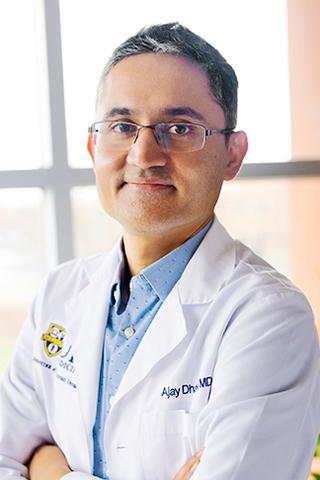
The dangerous Ajay Dhakal MBBS. Doesn’t it look like a mugshot? Well, it’s from his LinkedIn page (https://www.linkedin.com/in/ajaydhakal/). . .but it still looks like a mugshot.
I didn’t walk, I ran to a great big research hospital, believing that great big research hospitals hire only the best physicians. I learned (again, the hard way) that they don’t. Shipra Gandhi, MD, who works at the great big research hospital I ran to (Roswell Park Cancer Institute in Buffalo, NY) doesn’t actually do much patient care. She hides behind her “team,” which does it for her.

Shipra Ghandi MD, trying very hard to smile. Take a good look at her because once you are her patient you won’t see her. You will see “the team“ instead (but will pay physician prices for the privilege). From https://medicine.buffalo.edu/faculty/profile.html?ubit=shipraga
It took me about a year to discover “the team” is short on knowledge, abrupt with care, and arrogant in their refusal to properly chart office visits. I then found that “the team” and Dr. Gandhi shared rigid, generic notions about the course breast cancer should take; unfortunately, my disease and medical history did not conform to any of these. So, they struggled to make them conform. They consistently minimized, trivialized, denied, and otherwise sanitized both my medical profile AND diagnosis to satisfy their one-size-fits-all care plan. They refused to keep me informed and dismissed my questions. When I sought advice from the Patient Advocate, she didn’t help me; instead, she mollified Dr. Gandhi and “the team” by forcing me to accept a “don’t ask, don’t tell” plan of care that effectively rendered any interaction with my providers impossible and endorsed “care” so minimal that it could easily be accomplished during a three-minute phone call.
Which was horrifying — not as debilitating or dangerous as Dr. Dhakal’s special kind of “care,” but horrifying nonetheless.

So, it was time to go doctor-shopping once more.
This time I wasn’t running from a doctor whose “personal care” included near-fatal ignorance. This time I wasn’t mistaking bull**** from an invisible doctor for medical care. Although the care offered by Shipra Gandhi, hiding behind her “team,” was thoughtless, arrogant, brusque, judgmental, and deficient, it wouldn’t kill me — not right away, anyway — so I could invest some time in finding a competent, knowledgeable, and trustworthy doctor who would not blame me for my medical status or distort it to fit into a predetermined treatment plan or ignore the parts they didn’t like. This time I could take all the time I needed to find that physician.
So I did. Using the procedure outlined above, I will chose an oncologist — hopefully for the last time.
Today (February 20, 2024) was my first second opinion. The doctor I saw speaks English. She is unencumbered by a culture that has a Dalit caste — persons deemed untouchable — or practices female infanticide or requires women to cover their hair and walk two steps behind their husbands or considers the left hand “impious.” She was thorough in her workup and forthcoming with her explanations. She listened intently to what I had to say and asked me appropriate questions. She outlined a personalized plan of care that puts the Roswell ” team” plan to shame. In comparison, I am shocked that I put up with that bull**** for so long!
I am hopeful that I will find a good medical relationship. But if it doesn’t work out, I can always start over. . .because ultimately I am the one who must look out for me. I am my own confidant and advisor.

PS Dr. Gandhi — you’re fired.
So is your “team.”
Especially Alison.






































 Beat Breast Cancer
You must be logged in to post a comment.